A Japanese sword is designed to slice. An ax is designed to chop. The mass and balance of a sword is designed to slice at the tip, instead of chopping near the hands. Since this is the case, a sword’s tip should move along the greatest arc from a center point. By applying the principles of math, the longer the radius of a circle, the longer the arc. If the sword takes the same amount of time to travel a greater distance, greater radius=greater circumference, then the sword is moving faster with the greater distance.
A swordsman contributes his mass to the mass of the sword to increase the penetration of the cut. The strongest part of a human’s body is the hips and center, which means if we integrate our center into the cut, we are able have greater penetration and a larger radius. By cutting from our centers we employ both of these principles to create a more powerful cut. Keep training!
Iaido, as a path, always teaches its practitioners. There is always something new. A true student will go beyond the moment and unpack all its meaning. Some moments are small and some are momentous, yet each is equally important. Most of us don’t listen to the lessons in every moment and require more dramatic events to make us stop and think. One such event happened while training when one of the student’s iaito broke. The article below contains his reflections and inspired learning as a result of the event. Keep training, and listen to and soak in what your teacher is trying to tell you.
The following article appeared in the Boulder Daily Camera on April 16, 2012. [The location, prices, times and contact information are VERY dated and are no longer current]
Boulder Daily Camera
Workout of the week: Japanese swordsmanship
By Liz Moskow For the Camera April 16, 2012 Publication: Daily Camera, The (Boulder, CO) Word Count: 1763
Bright Horizons, 1818 Centennial Dr., iaidotsj.org, 303-547-0298, Louisville on Thursdays; Boulder Circus Center, 4747 N. 26th Ave., Boulder on Saturdays
Instructor: Steven Shaw Sensei says he was destined to teach the Japanese martial art of Iaido. Like other boys, as a child, Shaw mimicked Luke Skywalker as he wielded his Lightsaber to fight off evil. However, Shaw’s interest in battle play lingered. As a young adult, he practiced self-taught sword techniques in Los Angeles with a friend who had just bought his first samurai sword. During one particular rigorous session, a stranger saw him practicing and suggested that he study with Rev. Kensho Furuya at the Aikido Center of LA. He has been on a path toward mastering Iaido and Aikido ever since, having owned his own Dojo in Littleton. Shaw Sensei moved to the Boulder area and currently trains under Izawa Sensei at Aikikai Tanshinjuku. He teaches both adults and children twice a week.
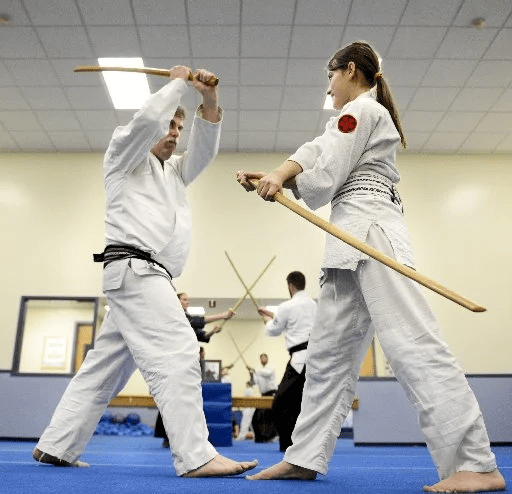
Equipment used: Practitioners of Iaido wear a traditional training uniform called a keikogi — a basic white robe and loose-fitting pants. Over the keikogi, the hakama, or samurai-style pants, are tied. Beginner students in Iaido use a bokken — a wooden sword that simulates the use of a real one without the risk of injury. A steel fighting sword is called an Iaito.
What is the workout? I inquired about “the sword-fighting class,” as the thought of emulating Uma Thurman as Black Mamba in “Kill Bill” had a certain appeal. I learned quickly, however, that Iaido is not a ” sword-fighting class,” but a class to teach the way of the sword. Loosely translated, Iaido means “the way of drawing and cutting.” He went on to explain that the true art of Iaido teaches precise practiced techniques of evasion and attack designed to end battles quickly and to deliver an honorable death in three moves or less. Iaido isn’t Hollywood-style sword fighting, it’s Zen-like and more in line with my yoga background than I had thought.
The class begins with bowing in, also called rei. Suburi, or the basic, first swordsman position, is practiced next. This looks similar to ballet’s first position, with feet turned slightly outward. The bokken is raised above and in front, making a firm cutting action while using the legs and core for propulsion. Beginners often spend the majority of the class repeating suburi over and over. In true Mr. Miyagi fashion, students might also continue with the suburi “paint the fence” style during the second class. If you’re lucky, you’ll get to move on to second position: right foot forward and left foot behind in one balanced, centered line, then you get to switch!
In my first class, I practiced with mixed levels, so I got to watch and experiment with noto, the drawing and resheathing of the Iaito. Shaw Sensei sometimes gives students an unedged sword to try to get the feel for this. Removing the sheath in a stealthy and unencumbered manner requires patience and practice.
Moving on to the kata, or Iaido forms, part of the class, Sensei demonstrates ways to unsheathe, attack and resheathe. We practiced three different maneuvers before moving on to partner practice. We took turns pretending to split each other’s skulls, evading and counter-attacking with a mock-wrist-severing/bilateral-brain-slicing technique.
Multiple bows-out conclude the instruction part of the class.
All that is left to do is clean the “blood” and sweat off your sword. Students took special care to wax, polish and clean their Iaitos. This ritualistic cleaning keeps the swords pristine and ready for the next battle.
What’s different? Iaido is different from other martial arts in that its maneuvers are circular rather than linear. The footwork, or suriashi, is also very different. Practitioners of Aikido and Iaido practice toitsu-tai– a unified state of being where feet, hips, shoulders and hands form parallel lines, integrating power to the center.
Cost: $50 a month with no contract buys you instruction twice a week. Students intending to commit to Iaido should also expect to spend $250 on a training uniform, and although they first practice with a bokken (wooden sword), a proper training sword will cost around $400.
Level: Depending on personal body awareness, this class varies in difficulty. On a scale of 1-10 in intensity, this class is about a 4, as most of the time you are learning technique rather than intensely practicing drills.
When: Thursdays 6:45-7:30 p.m. and Saturdays 7-9 a.m.
What to prepare: Loose, comfortable clothing. Iaido is practiced barefoot.
Muscles worked: Full body, initial strain to the forearm
What I loved: I loved that I kept finding parity with other sports or activities that I currently practice or have tried. I was able to draw on muscle memory from ballet, fly fishing, golf and yoga to make myself understand the moves more easily.
What I didn’t like: Like most martial arts, Iaido is very regimented. I’m not one to practice one kick 1,000 times and enjoy it. But how else could one ever become a feared yet respected Samurai? I’ll defer to the great Bruce Lee on this one: “I fear not the man who has practiced 10,000 kicks once, but I fear the man who has practiced one kick 10,000 times.”
How I felt after the class: No noticeable soreness after class. Slight forearm stiffness the next day.
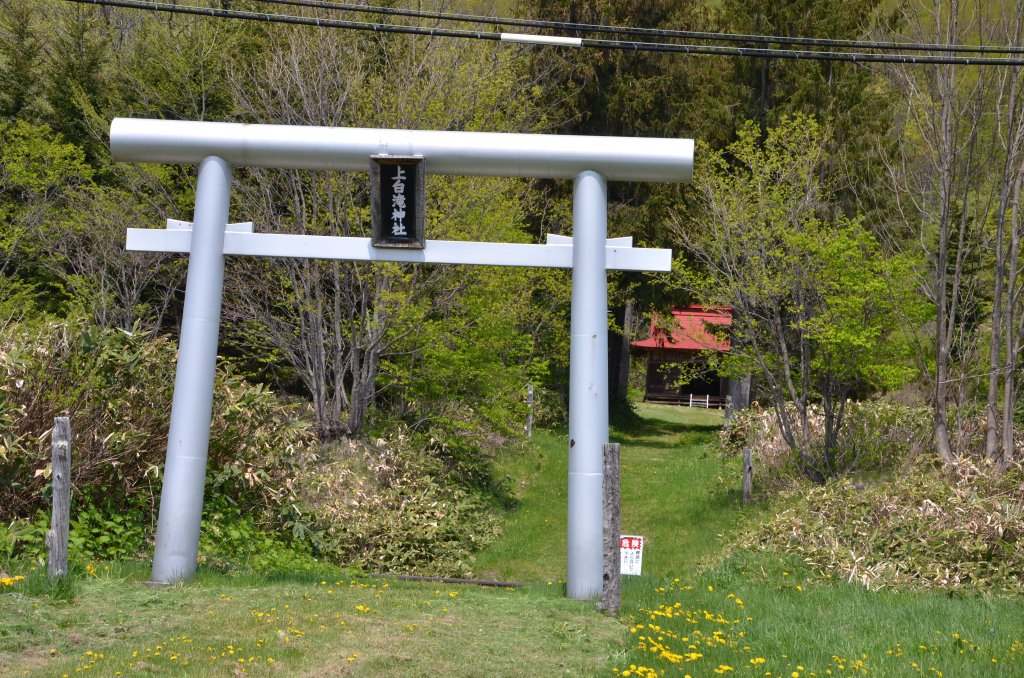
There are many paths we walk. Sometimes they are groomed by our teachers, and sometimes we must carve them out of the wild using the techniques and methods of our teachers. This path leads to a shrine O’Sensei helped create on the Northern island of Hokkaido. Keep training to stay on the path.
There are many obstacles when training in Aikido and Iaido. The biggest one I face is the language barrier. There are so many Japanese phrases that have approximate English translation definitions. One of my Iaido students has been trying to teach me some Japanese, though he, himself, isn’t fluent. He gave me a dictionary and I consult it often in an effort to gain a greater understanding. In the process of looking up “center”, which I still haven’t found in the dictionary, I came across the word “kaitenjiku” (shaft on which something turns). I’ve been pondering this word and its implications in Aikido and Iaido.
As an Iaidoist, the concept of kaitenjiku is more applicable to Sato, Uto, Atarito, Ryuto, or any turning technique. Again, the head and the hips should be in alignment. By keeping the hip and head strong, the sword is able to move faster and with more stability. I think of a car with its wheels. If the axle is not stable, the rotation becomes more of a wobble instead of a smooth movement. The efficiency of the momentum is wasted and energy transfer is lost. The same occurs with the sword. If the center isn’t stable, the maximum transfer of energy to the tip of the sword is lost. The kaitenjiku becomes the fulcrum or “shiten” around which the sword moves. It is common for beginning iaidoists to lunge forward when drawing the sword and executing the first horizontal cut from seiza. When one does this, the hip and head are no longer in alignment. The head is closer to the target/danger, and the shiten becomes the shoulder. By keeping the hip on top of the back knee and keeping the chin back, one maintains his center, posture, breath, and strength as well as fluid, powerful sword movement.
So far this discussion has been focusing on the concept of the axle, or kaitenjiku, but what about the tension and torque created when something is wound around that axle? That’s when nenten comes into play. Nenten, translated in another dictionary, means torque, or torsion. So how does torque, or torsion apply to Aikido and Iaido?
In Muso Shinden Ryu Iaido, the draw comes from the center. It’s as though the blade springs from one’s belly. Many Iaidoists only use the right arm and shoulder to cut to where they integrate the wrist, elbow, and shoulder to create one motion cutting. After I had trained for a few years in Iaido, Furuya Sensei suggested that I get a shinken. He said he had the perfect sword for me, and when I went to class one day he presented me with a sword in shirasaya. He wanted to see if I could draw it. The cutting edge is thirty-three inches long. This is an incredibly long sword. I stretched and barely got the sword out of the saya. “That sword is good for you.” After training with this sword for the last six years, I have made some discoveries. One of them relates directly to the subject of this essay. In order to draw the sword from my center, I have to rotate my hip while completing saya biki. My hip rotates at the base of my kaitenjiku while my head stays stable. This creates tension and torque in my upper body. When I release the tension in my hip, it helps move the sword through space. Instead of just using my shoulder, elbow, and wrist to cut, I am adding another element, my hip. I coil my body, like a spring, employ the Nenten, and release the tension in a powerful nukiutsuki. Without the long sword, I wouldn’t need to use my hip to help draw, and the torsion would never have been created.
No matter what our goals are in life, good posture can’t hurt. Stay relaxed, centered and focused. Keep Training!
At the end of kirioroshi(vertical downward cut) the hands should be slightly below the knee. Note the angle of the sword and thigh. Even though the cut is finished, the feeling with the tip is still pressing down. Keep training!
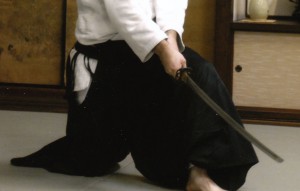
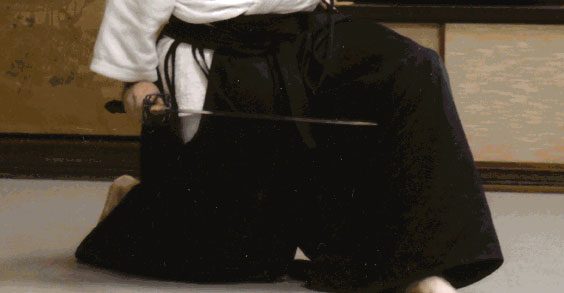
When doing the first chiburi in Inyoshintai(also known as Eishin ryu chiburi or Suhei noto[horizontal or level] chiburi), it is important to keep the blade edge to the right and the tip slightly lower than the hand so that a drop of water/blood could roll down the slope. If executing Suhei noto chiburi, one should keep the sword parallel to the ground. Regardless of chiburi style, the tip of the blade should always be pointed forward. The right hand should be in line with the right leg, and the feeling with the right hand, and its extension the tip, is pressing down. Keep training!
 Iaido Tanshinjuku